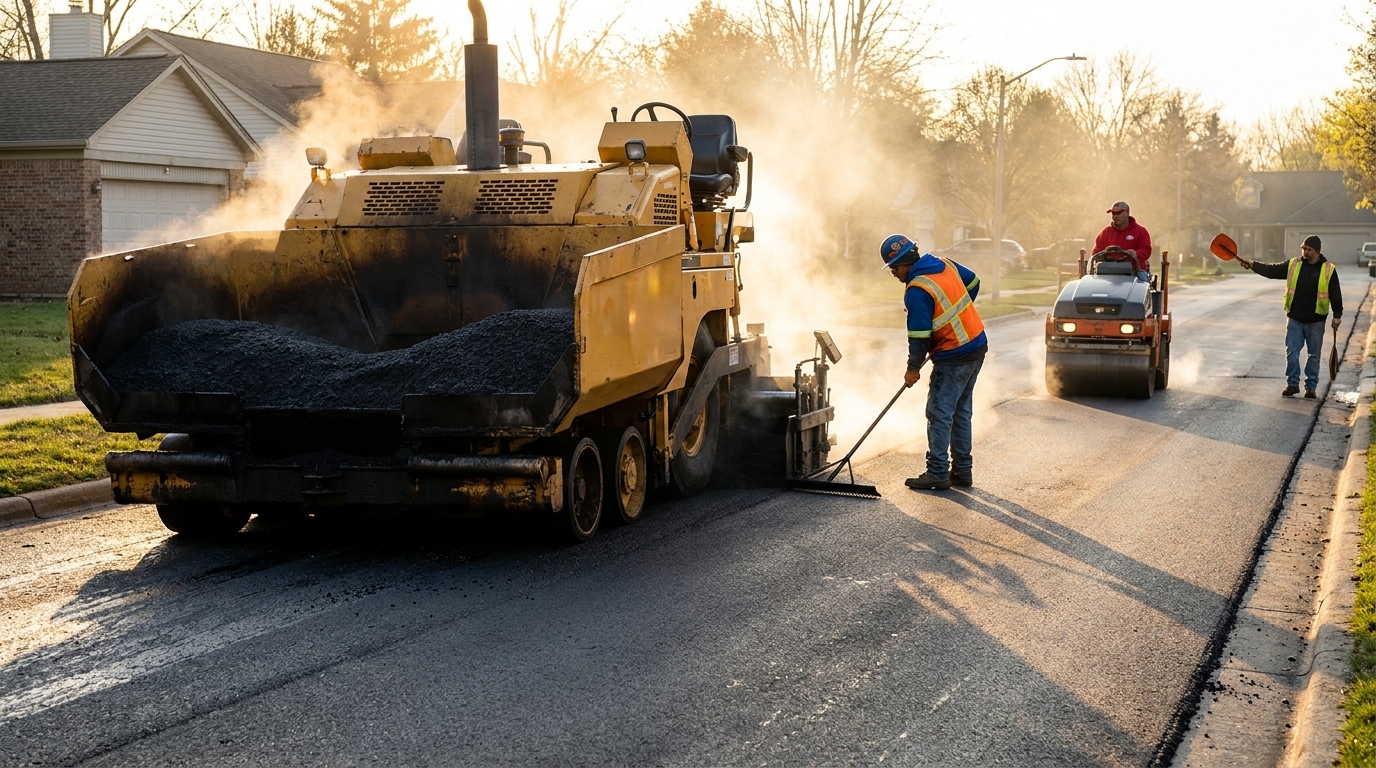
Sealcoating season runs maybe six months in most of the country. In the northern states, you're working April through October if the weather cooperates. That's a short window to book, price, crew up, and deliver enough work to carry the business through the off-season. Most contractors don't lose jobs because of bad pricing. They lose revenue because scheduling falls apart.
Double-bookings, crew bottlenecks, weather-day chaos, and back-to-back jobs that don't account for cure time are the real margin killers. And yet most scheduling advice in the paving industry focuses on tools and software, not on the actual workflow decisions that determine whether you finish the season profitable or stretched thin.
The decisions that matter most: how to structure your job pipeline, how to build crew capacity without overcommitting, and how to keep clients from walking when plans shift.
Why Sealcoating Scheduling Is Different From Other Paving Work
Asphalt paving jobs tend to be larger, fewer, and easier to space out. Sealcoating is the opposite. You might run 5 to 10 jobs per crew per week during peak season. Each one is weather-dependent, time-sensitive (sealant needs dry pavement and the right temperature range), and usually client-sensitive because you're working around driveways, parking lots, and active businesses.
That volume creates a specific scheduling problem: the margin between "fully booked" and "catastrophically overbooked" is razor thin. One rained-out day can create a chain reaction that pushes every job back by 24 to 48 hours. If you didn't build buffer into your schedule, that wave hits your clients all at once, and your phone blows up.
Sealcoating also has a cure time constraint most contractors underestimate. Freshly sealed pavement needs 24 to 48 hours before vehicle traffic, depending on temperature, humidity, and the product used. If a property manager expects their lot open for business the next morning and you don't communicate that clearly upfront, you've got a problem that no scheduling software fixes.
Build Your Schedule Around Crew Capacity, Not Just Calendar Slots
Most contractors schedule by day: Monday through Friday, slot in jobs, fill the week. The problem is that a "day" isn't a fixed unit of production in sealcoating. A two-person crew on a residential driveway might turn over four or five jobs in a day. That same crew on a mid-size commercial lot might spend the entire day on one job. Treating every day the same way creates false confidence in your booking.
A more reliable approach is to schedule by crew-hours, not by calendar squares. Estimate how many crew-hours each job actually requires, including drive time, prep work, application, and cleanup, and then fill your week to about 80% of total available crew-hours. That 20% buffer absorbs a short weather delay or a job that runs long without wrecking everything behind it.
If you're running multiple crews, assign each one a geographic zone for the week. Routing matters in sealcoating because material degrades and equipment needs to stay warm. Crews that spend 45 minutes between jobs in traffic are less productive than crews that knock out four jobs within three miles of each other. Zone-based scheduling isn't just about efficiency. It's about keeping your crews from burning out mid-season.
How Many Jobs Can One Crew Realistically Handle?
A standard two-person sealcoating crew with a squeegee/spray rig can handle roughly 15,000 to 25,000 square feet per day under normal conditions. That translates to anywhere from two to eight jobs depending on job size. The right number for your operation depends on your equipment, product application rate, and how much prep work (crack filling, edging, blowing off debris) is factored into each job.
Know your own numbers. Track time per job for two or three weeks and calculate your actual average. Then use that to build your booking template rather than guessing. Contractors who track crew-hours per job consistently outbook competitors who estimate loosely, because they know exactly when they're full and exactly where there's room.
Handle Weather Delays Without Losing Clients
Sealcoating needs pavement surface temperatures above 50°F and no rain in the forecast for at least 24 hours post-application. That's a real constraint, not a preference. Rain on fresh sealant can wash it off entirely, leaving the client with a failed job and you with a redo at your own cost.
The contractors who handle weather delays best do two things differently. First, they set expectations before the job is booked. Not in fine print. Right in the proposal, in plain language: "Sealcoating requires dry conditions and pavement temps above 50°F. If weather forces a reschedule, we'll contact you within 24 hours and get you into the next available slot." When clients know this upfront, a delay reads as professionalism, not a red flag.
Second, they keep a short "weather reserve" list, jobs that clients know could get bumped up if another job reschedules due to rain. Clients who are flexible get slotted into that list. When a weather day opens up an unexpected slot, you fill it fast instead of eating dead time.
A rain delay isn't a scheduling failure. It's a communication test. The crews who win client loyalty during delays are the ones who call first, before the client has to ask.
Build a Simple Rescheduling Protocol
Every crew supervisor should know exactly what to do when a job has to move. That means a set process, not an ad-hoc call to the office. A basic protocol looks like this: if weather forces a delay by 6 a.m., the crew lead calls the client by 7 a.m., confirms the reschedule window, and updates the job status in whatever system you're using. No surprises, no silence.
The rescheduled job goes into the next available slot, with a note in the client record. Clients who get proactive calls almost always understand. Clients who find out a crew isn't coming by waiting at their property don't forget it.
Avoid Overbooking When Demand Spikes
Late summer is when the overbooking traps spring. Demand surges as property managers try to get lots sealed before fall, and homeowners realize their driveway has been on the to-do list all season. Inquiries stack up fast, and it's tempting to say yes to everything. That's where the damage happens.
Overbooking doesn't just hurt the clients you push back. It degrades quality on the jobs you try to rush. Crews that are pressed to finish faster skip prep steps. Prep shortcuts in sealcoating show up within one season: thin coverage, peeling edges, missed crack filling. That's warranty work you're absorbing next spring.
The fix is a hard booking horizon. Know your current lead time, say two weeks, and only commit to jobs that fit within it at your current crew capacity. Once you're full, give the client an honest date and let them decide. Some will wait. Some won't. Either outcome is better than overpromising and underdelivering.
If demand consistently outpaces your capacity, that's a crew-scaling decision, not a scheduling fix. Running a second crew requires its own setup: equipment, a crew lead who can manage independently, and enough jobs in the pipeline to make it financially worthwhile. That's a deliberate expansion, not a reaction to a busy week.
For contractors looking at how to price jobs before they schedule them, the sealcoating pricing per square foot guide covers how to build rates that account for your real production costs. Getting the price right before the job hits the calendar is what keeps scheduling profitable, not just busy.
Use Proposals and Job Tracking to Keep the Schedule Honest
A common scheduling breakdown happens between the proposal stage and the actual job date. A client accepts a quote, you mentally slot them in, and two weeks later you're not sure if they're confirmed, if they've paid a deposit, or if the job details even match what the crew has on their work order. This is where informal systems fail at scale.
When every accepted proposal automatically creates a job record with the date, scope, crew assignment, and client contact, you stop relying on memory and sticky notes. The schedule is only as accurate as the information feeding it. If proposals are sitting in an email thread and jobs are tracked on a whiteboard, the schedule will have gaps, conflicts, and surprises.
Paver connects proposals to job tracking in one flow. You send a paving proposal that clients can review and sign digitally, and once it's accepted, the job moves into your active pipeline. No manual transfer, no duplicate entry. That matters more when you're running multiple crews and can't afford to have one job fall through the cracks because the paperwork didn't follow the conversation.
If you're still evaluating what to look for in scheduling and estimating tools, the breakdown of what paving estimating software should actually do is worth reading before you commit to anything. The right tool should cut your admin time, not add a new system to manage.
Confirm Every Job 48 Hours Out
Make it standard practice to confirm every job 48 hours before the scheduled date. A short text or call to the client verifies they're ready, the surface is clear, and any access issues are handled before the crew shows up. This also gives you a last window to catch weather risk and reset expectations before the day of.
Crews that show up to jobs where the parking lot isn't clear, the gate is locked, or the client forgot they had it scheduled waste time that can't be recovered. A 48-hour confirmation eliminates most of those surprises.
Plan the Off-Season Now, Not in March
The contractors who hit the ground running in spring are the ones who used the winter to build their pipeline. That means following up on jobs that didn't close in the fall, sending proposals to commercial accounts before they start taking bids, and locking in repeat customers with early-season pricing if that fits your model.
Scheduling isn't just a peak-season problem. The work you do between October and March directly determines how fast you fill up your spring calendar. A backlog of proposals ready to convert in April means you start the season with a full schedule instead of scrambling to fill the first two weeks.
Start sending faster estimates and get more of them signed before spring. Try Paver free and see how much time you recover on the front end of every job. No credit card required.